
Workplace Trends & Research
The Evolution of GCCs: From Back Office to Innovation Hub
Global Capability Centres in India began in 1985 with a single software design centre in Bengaluru. Four decades later, they lead product development, R&D and AI for the world's biggest companies. Here is how GCCs evolved, decade by decade.
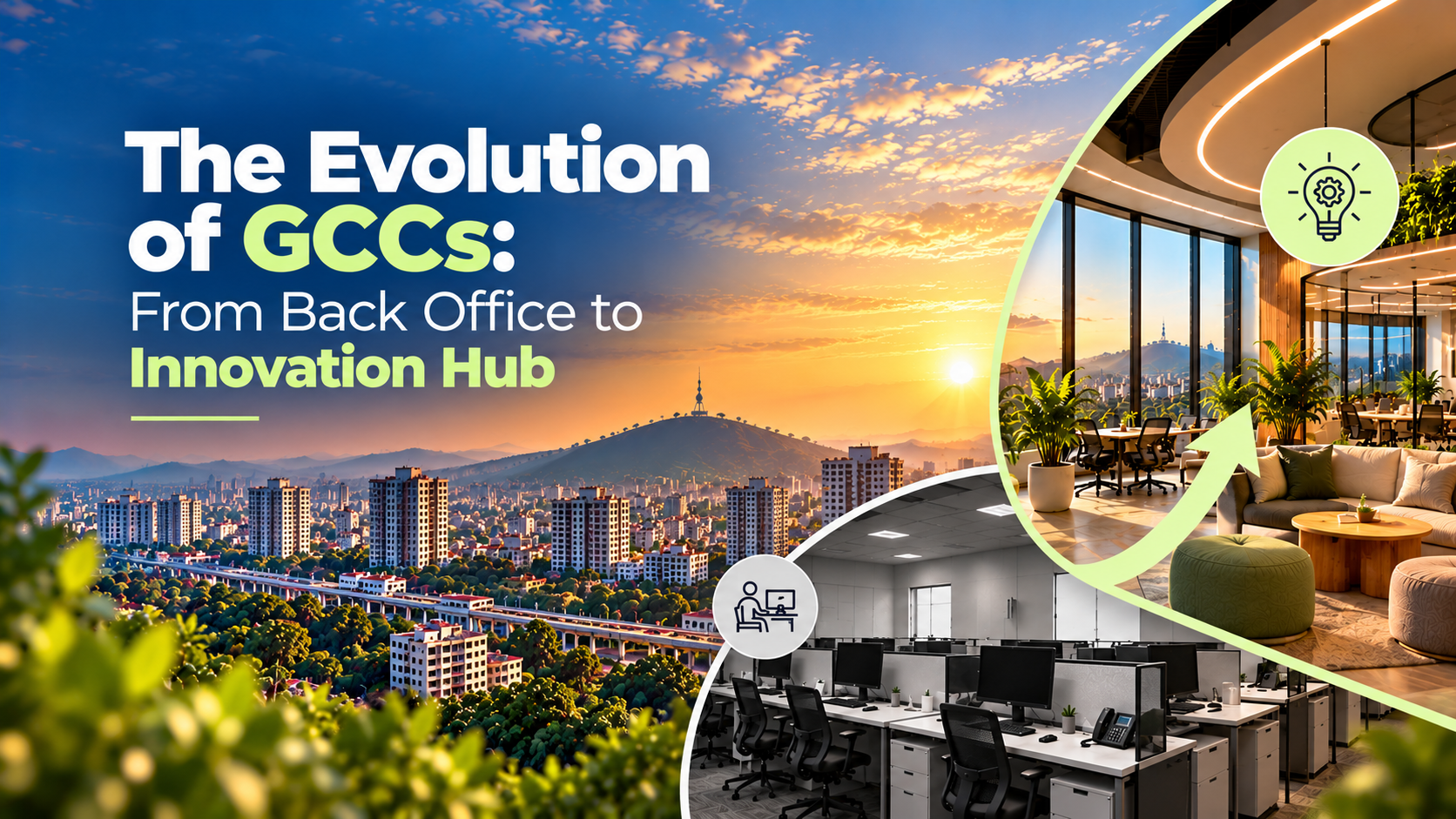
Global Capability Centres (GCCs) have come a long way. What began as a few offshore teams writing code and processing transactions has become a network of more than 1,700 centres in India that design products, run global functions and lead innovation for their parent companies.
Understanding the evolution of GCCs helps explain where they are heading next, and what that means for companies planning a centre today.
Where it started: 1985
The story of GCCs in India is usually traced to 1985, when Texas Instruments set up a software design centre in Bengaluru. According to Zinnov, it was the country's first multinational software design centre. The team famously connected with headquarters in the US via satellite, at a time when India's technology infrastructure was still very limited.
Phase 1: Captive cost centres (late 1980s to 1990s)
In the early years, these centres were called “captives” or offshore development centres. Their main purpose was cost savings.
- Back-office processing, IT support and code maintenance
- Work defined by headquarters, delivered by India teams
- Success measured mainly by cost reduction
By the late 1990s, companies such as Microsoft, GE and IBM had set up development hubs in cities including Hyderabad, Bengaluru, NCR and Pune.
Phase 2: Capability and scale (2000s)
In the 2000s, companies realised India could do far more than low-cost work. Centres grew in size and scope:
- Application development, testing and analytics
- Shared services for finance, HR and procurement
- Multiple centres across Bengaluru, Hyderabad, Pune, Chennai and NCR
- Stronger local leadership teams
Phase 3: Centres of excellence (2010s)
The 2010s saw global tech giants build large campuses in India, such as Google in Hyderabad and Bengaluru and Apple's maps development centre in Hyderabad. Centres began to own products and platforms end to end. The term “Global Capability Centre” replaced “captive”, reflecting this broader role.
- Product ownership and engineering R&D
- Digital, cloud and data platforms
- Global roles based in India
Phase 4: Innovation and leadership hubs (2020s)
- Lead AI, cybersecurity and advanced engineering work
- House global leadership roles and decision-makers
- Drive transformation programmes for the whole company
- Include mid-sized companies, not just large multinationals
How GCCs changed, at a glance
Era | Main role | Typical work | How success is measured |
|---|---|---|---|
1985–1990s | Cost centre | Back office, IT support, maintenance | Cost savings |
2000s | Capability centre | Development, testing, shared services | Scale and quality |
2010s | Centre of excellence | Products, platforms, R&D | Ownership and outcomes |
2020s | Innovation hub | AI, global leadership, transformation | Business impact and innovation |
What's next for GCCs
- More AI-led work: GCCs will build and run AI products for global markets.
- More global leaders in India: Decision-making will continue to shift to India.
- New cities: Pune, Hyderabad and emerging Tier-II cities will keep gaining share.
- Smaller companies: Mid-market firms will increasingly set up their own GCCs.
- Flexible workspaces: More GCCs will start in managed offices to launch faster.
Learn more in the rise of GCCs in India and why Pune is the new frontier for GCCs.
Build the next chapter in Pune with Bootstart
Bootstart's GCC Partnership helps organisations set up and scale GCCs in Pune with consulting, design and build, and fully managed workspaces across 8 centres.
Planning your GCC? Explore our GCC Partnership.
FAQs