Introduction
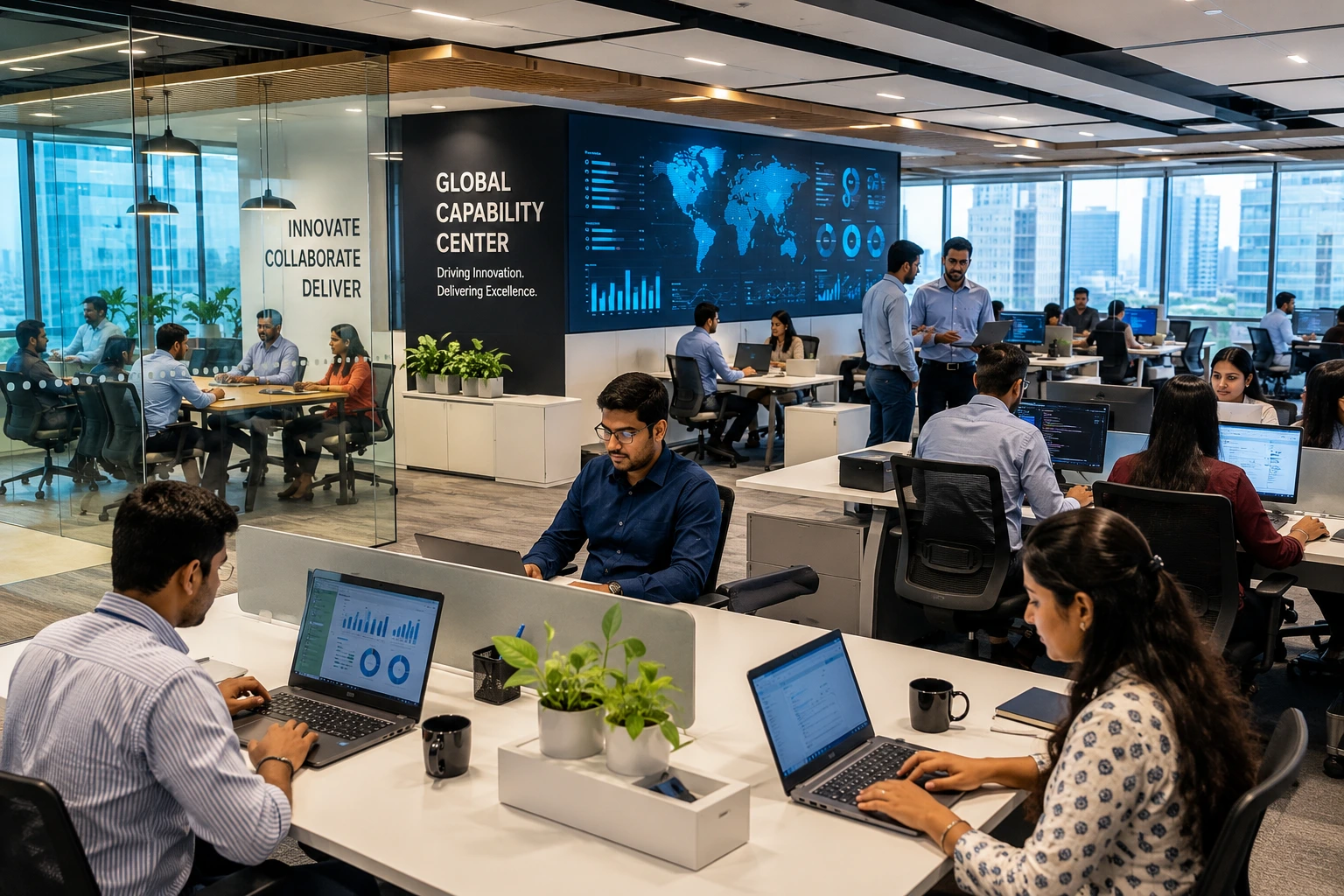
The concept of how a company expands globally has undergone a radical transformation. What started as a search for affordable workforce has now turned into a high-stakes race for innovation and strategic control. Today, GCCs are not back-offices. They are innovation labs, product development engines, AI research hubs, and strategic command centers, wholly owned by the world’s largest corporations, staffed by some of the sharpest minds in technology, and deeply embedded in the decisions that shape global business. Companies like Bootstart are contributing to this ecosystem by enabling flexible and scalable work environments for growing enterprises and innovation-driven teams.
Here is a look at how GCC emerged, how they have evolved through four distinct phases, and where they are headed.
Why Did GCCs Emerge?
The “back-office” model eventually reached its limits. Companies realized that relying on third-party
middlemen often led to fragmented innovation and security risks. This triggered a tectonic shift toward
“strategic ownership”.
Multinationals began bypassing vendors to build wholly-owned extensions of their own headquarters. By
building their own teams, particularly in talent-rich hubs like India, companies gained:
- Direct ownership of their processes.
- Stronger security for intellectual property
- Better innovation by integrating global teams into the company's core culture.
- GCC provided access to skilled talent.
The Old Model
Current GCC Model
US company → builds its own India team for direct ownership, better innovation, and stronger security.
The rise of modern work ecosystems and the availability of Top coworking space in pune locations have further accelerated the ease with which global companies can establish and scale GCC operations quickly.
The Four Phases
The Evolution Phase by Phase
The transformation of GCCs from cost centers to command centers followed a recognizable arc. Four distinct
phases, each building on the last, each requiring a fundamental shift in mindset from both the GCC and its
parent company.
| 1. Vision & Strategy | The Cost Saving Mandate The first GCCs were built with one question in mind: how much can we save? Headquarters identified specific processes like data entry, IT maintenance, finance operations that could be migrated offshore with minimal risk. Talent was hired for compliance and execution, not creativity. KPIs were entirely cost-focused: savings percentages, SLA adherence. These centers reported into support functions, never into the strategic core. Useful, but invisible. |
| 2. Setup & Growth | Building the Foundation As companies grew more confident, investment increased. Centers expanded from a handful of functions to a broader portfolio. A second generation of talent; more specialized, more senior joined the workforce. Functions once considered too sensitive to offshore like legal support, financial analysis, product testing began to migrate. The GCC was no longer just a cost play; it was a capability. Yet the fundamental dynamic remained: HQ decided, the GCC delivered. |
| 3. Hypergrowth | The Talent Transformation Phase 3 is where the story becomes genuinely remarkable. Driven by the explosion of digital technology like cloud, mobile, data, AI; companies needed capabilities that simply did not exist at sufficient scale in their home markets. A new generation of talent arrived: deep-tech engineers, data scientists, AI/ML specialists, some with PhDs. They filed patents. They owned products. They reported directly to global CTOs and CPOs. The centers were no longer peripheral they were core. The demand for premium infrastructure and agile workplaces also led to the emergence of the Best coworking space in Pune, supporting innovation teams, startup collaborations, and global GCC expansion. |
| 4. Strategic Ownership & AI Integration | The Talent Transformation Phase 3 is where the story becomes genuinely remarkable. Driven by the explosion of digital technology like cloud, mobile, data, AI; companies needed capabilities that simply did not exist at sufficient scale in their home markets. A new generation of talent arrived: deep-tech engineers, data scientists, AI/ML specialists, some with PhDs. They filed patents. They owned products. They reported directly to global CTOs and CPOs. The centers were no longer peripheral they were core. The demand for premium infrastructure and agile workplaces also led to the emergence of the Best coworking space in Pune, supporting innovation teams, startup collaborations, and global GCC expansion. |
The Transformation
Cost Centre → Innovation Hub
| Dimension | Traditional Cost Centre (Phase 1-2) | Innovation Hub (Phase 3-4) |
|---|---|---|
| Primary Goal | Labor arbitrage & cost reduction | R&D and strategic value creation |
| Talent Profile | Process-oriented, mid-skill | Deep tech, PhDs, AI/ML engineers |
| Reporting Line | Support function / back-office | Direct to global CTO / CPO / CEO |
| Decision Authority | Execution only | Strategic input & product ownership |
| Key Metrics | Cost savings %, SLA adherence | Patents filed, Revenue impact, NPS |
| Typical Roles | BPO, IT support, data entry | Product Managers, UX Designers, AI Research |
The Future
What Does Phase 5 Look Like?
If Phases 1 through 4 tell the story of what GCCs have become, the next chapter is about what they will be. As
we look toward 2030, the GCC is no longer an “experiment” it is the Digital Core of the modern enterprise. We
have officially entered Phase 4, where AI integration is the norm.
| AI as Native Infrastructure | The GCCs of 2030 will not be experimenting with AI they will be built around it. Generative AI, autonomous agents, and intelligent automation will be embedded in every function. The centers building these capabilities today will define the competitive landscape tomorrow. |
| Rise of Tier-2 Cities | While Bengaluru, Hyderabad, and Pune remain dominant, the next wave of GCC growth is already reaching Coimbatore, Jaipur, Ahmedabad, and Kochi where talent depth is strong, attrition is lower, and value is greater. |
| ESG Integration | As global companies face mounting ESG pressure, GCCs are becoming the operational backbone of sustainability delivery, managing carbon reporting, responsible supply chains, and governance data at scale. |
| The Intensifying Talent War | As GCCs mature, the talent pool will shift from process-oriented, mid-skill workers to highly specialized roles, including Deep Tech experts, PhDs, AI/ML engineers, and UX Designers. These teams will be responsible for filing patents and creating direct revenue impact for the parent company. The increasing need for scalability and operational flexibility has also increased demand for Office space on rent Pune among multinational companies establishing or expanding GCC operations. |
Frequently Asked Question (FAQs)
It refers to the journey of GCCs from simple cost-cutting offshore units in the 1980s to fully strategic, AIpowered extensions of global enterprises today.
The four phases are Vision & Strategy (cost-saving), Setup & Growth (expanding services), Hypergrowth
(deep tech and innovation), and Strategic Ownership (AI integration and full strategic leadership).
Most mature GCCs are in Phase 3 or Phase 4 either in hypergrowth mode building deep tech capabilities
or fully integrated as strategic innovation hubs reporting directly to global leadership.
Outsourcing meant losing control over IP, quality, and strategy. GCCs gave companies full ownership,
better alignment, and long-term cost efficiency without the risks of a third-party vendor.
In traditional outsourcing, third-party vendors manage repetitive tasks; in the GCC model, the parent
company builds its own team for direct ownership, better innovation, and stronger security.
Conclusion
Three decades ago a handful of multinationals made a quiet bet; that moving work to India could save money. What they could not have known was that this bet would grow into something far more profound: a complete reimagining of how global enterprise are built, staffed, and led.
Today the GCC that began as a back-office utility is a Reinvention Centre. It files patents. It builds products. It shapes strategy. By reaching Phase 4, these centers are no longer peripheral support units; they have become the Digital Core of the modern enterprise, directly integrating AI and high-level R&D into the company’s global mission.
And yet, the most exciting chapter is yet to come. As AI becomes native infrastructure, as Tier-2 cities unlock the next wave of talent, the ceiling of what these centers can become keeps rising.
Ultimately, the era of traditional outsourcing has been replaced by a model of direct control and collective innovation. For global leaders, the strategic question is no longer if they should establish a GCC, but how fast they can integrate one to remain agile and competitive in an increasingly complex world.