Introduction
Walk through Bengaluru, Hyderabad, or Pune today and the glass-fronted buildings housing global brands are no longer outsourcing vendors anymore. They’re strategic nerve centers — where a Fortune 500 bank builds its next risk models, where a retailer runs its supply chain analytics, where a healthcare company writes the code behind its patient platforms.
This is the story of India’s Global Capability Centers (GCCs) — one of the most significant, and least talked-about, shifts in global business over the last two decades. Whether you’re a CXO evaluating India, a GCC head bench-marking your center, or an expansion team building the case for Pune, this guide covers what a GCC is, how the model has evolved, why India leads, and why Pune specifically deserves a serious look. Companies exploring flexible infrastructure often begin with Top coworking space in pune options before making long-term real estate decisions.
What is a Global Capability Center (GCC)?
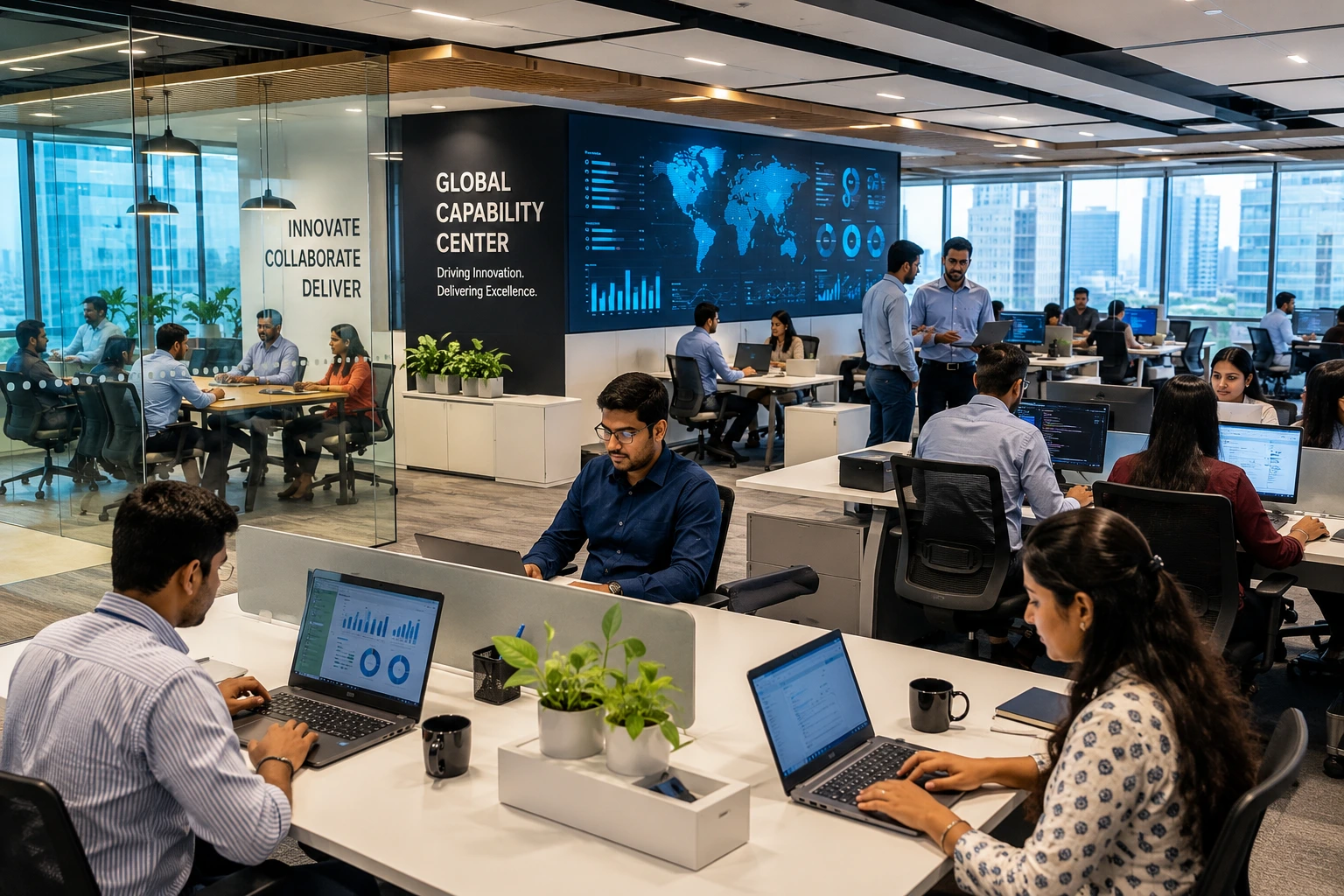
A Global Capability Center is a dedicated offshore unit that a multinational sets up to run critical business functions for its global operations — wholly owned and operated by the parent company, not a third-party vendor working on contract.
The term has replaced older labels like “captive center” or “offshore development center,” and the shift in language reflects a shift in purpose. Where captive centers were once cost-arbitrage plays, GCCs today are genuine capability hubs — built to develop engineering talent, analytics expertise, and operational resilience a company can’t easily build elsewhere.
How the GCC Model Has Evolved?
Understanding where GCCs are headed starts with understanding where they came from. The shift has happened in five fairly distinct waves.
● Wave 1: The cost-saving era
Late 1990s–early 2000s. Back-office work, data entry, and transactional finance moved to India almost entirely for labor arbitrage.
● Wave 2: The shared services phase
Finance, HR, procurement, and IT helpdesk consolidated into shared services models, shifting the goal from savings to standardization.
● Wave 3: The innovation center wave
By the 2010s, GCC teams began owning product development and analytics work core to the business, not just supporting it.
● Wave 4: AI and digital transformation
Data science and ML teams in Indian GCCs now often work on the same roadmap as headquarters — sometimes ahead of it.
● Wave 5: R&D hubs
The most mature GCCs generate genuine IP and patents. Some of the world’s most-used software features trace back to India.
This isn’t a uniform progression — plenty of GCCs still run as lean shared services centers, and that’s a perfectly valid model. But the ceiling has risen: a GCC today can be anything from a support function to a full innovation engine.
Why Companies Build GCCs?
The decision usually comes down to a handful of compounding benefits.
● Cost efficiency: Operating costs across talent, real estate, and infrastructure remain meaningfully lower than Western markets, even as wages rise.
● Access to skilled talent: India’s engineering, finance, and tech graduate pool gives access to specialized skills that are expensive to hire for at home.
● Innovation: Give capable teams real problems, not just transactional tasks, and GCCs become genuine sources of product ideas.
● Business continuity: Capability spread across regions and time zones reduces single-point-of-failure risk.
● Scalability: Scaling a team is faster and more flexible in India’s deep talent market than in tighter labor markets elsewhere.
● Time zone advantage: A well-run GCC extends operating hours meaningfully, enabling near-24-hour global coverage.
What Functions do GCCs Manage?
The range has expanded well past the back office. Modern GCCs commonly own:
● Engineering and software development — building core product features, not just maintenance
● Finance and accounting — from transactional processing to FP&A and treasury
● Human resources — talent acquisition, HR operations, and HR analytics
● Cybersecurity — dedicated security operations centers monitoring global infrastructure
● AI and machine learning — models and algorithms powering core products
● Data analytics and BI — turning global data into decisions
● Product development — owning entire product lines end to end
The common thread: ownership. A modern GCC isn’t executing someone else’s instructions remotely — it’s accountable for outcomes.
Why India Leads the Global GCC Market?
India isn’t the only country with a GCC ecosystem, but it’s the largest and most mature, for a few clear reasons: deep annual graduate talent supply, a cost structure that stays favorable even as salaries rise, a fluent English-speaking workforce, a 25-year-old IT services ecosystem that’s easy to plug into, active government incentives, and decades of surrounding BPO infrastructure that make setup considerably smoother than in newer markets.
Why Pune Is Emerging as India’s Next GCC Hub?
Bengaluru and Hyderabad get most of the headlines, but Pune has quietly built a strong case as a leading GCC destination in India.
● Talent pool: a deep bench of engineering and manufacturing talent, layered with a growing IT and startup ecosystem
● Universities: home to some of India’s most respected engineering and management institutions
● Infrastructure: well-planned business districts, expanding metro connectivity, and growing quality office supply
● Connectivity: proximity to Mumbai plus its own international airport, without the congestion of larger metros
● Cost advantage: meaningfully lower real estate and operating costs than Bengaluru or Mumbai, without compromising talent quality. Businesses comparing Office space on rent Pune options often evaluate flexible workspace solutions before committing to long-term leases.
● Quality of life: a manageable size and pleasant climate that make it easier to recruit and retain senior talent
Pune offers something rare – metro level talent and infrastructure at a cost, and quality of life that’s genuinely competitive.
Common Challenges in GCC Setup
Setting up a GCC is rarely simple. The recurring friction points: finding office space that matches timeline, brand, and growth plans; hiring at pace for leadership and specialized roles; navigating labor law, tax, and compliance as a company new to India; managing vendors across facilities, IT, and security; and scaling seats, floors, or locations without disrupting operations. Organizations looking for Managed offices Pune can significantly reduce setup timelines while maintaining operational flexibility. This is exactly why the workspace model a company chooses matters so much.
How to Accelerate Your GCC Setup?
Companies typically choose from four workspace models, each with real tradeoffs:
● Leased traditional office: full control over design and branding, but long lead times and upfront capital
● Managed office space: fully operational, move-in ready within weeks, with facilities and IT already in place
● Build-to-suit: a custom space for unique infrastructure needs — the slowest to execute
● Hybrid: start managed to get operational fast, then transition to a long-term leased or built space as headcount scales
There’s no universally right answer — it depends on timeline pressure, headcount plans, and how much operational complexity a company wants to own. But speed to operational readiness has become one of the biggest competitive factors in GCC setup: the companies that get from decision to desk-ready fastest gain the earliest advantage in hiring and ramp-up. Bootstart supports growing businesses with flexible workspace solutions, including coworking space in baner, premium Meeting rooms in Pune, and scalable office environments designed for expanding GCC teams.
Frequently Asked Questions (FAQs)
1. How long does GCC setup take in India?
It depends on the workspace model. A managed office can be operational within a few weeks; a fully built-to-suit facility can take months.
2. How many employees should a GCC start with?
There’s no fixed number, but most successful GCCs start lean — often 15 to 50 employees — to prove the operating model before scaling.
3. Why choose Pune for a Global Capability Center?
Pune combines talent depth, infrastructure, and connectivity with meaningfully lower costs than Bengaluru or Mumbai, without a compromise on quality.
4. What functions are commonly run out of a GCC?
Engineering, finance, HR, cybersecurity, AI/ML, data analytics, and increasingly, full end-to-end product ownership.
5. Is a GCC the same as an outsourcing vendor?
No. A GCC is wholly owned and operated by the parent company, run to the same standards as headquarters, not a third party working on contract.
Conclusion
India’s GCC story isn’t a trend — it’s a structural shift in how global companies build capability. Within India, Pune has emerged as a genuinely compelling destination: the talent and infrastructure of a major metro, with the cost efficiency and quality of life of a smaller one. India’s talent ecosystem, Pune’s growing infrastructure, and the right workspace partner together determine how quickly a GCC moves from plan to reality. Businesses seeking the Best coworking space in Pune can leverage flexible workspaces to establish and scale GCC operations efficiently.